Source: techcrunch.com
Few of the top AI labs have published or demonstrated containment response plans, according to a recent study by Guidelight AI Standards. A containment plan spells out what happens once an AI is caught trying to subvert human control — what access gets cut, and when the system gets shut down entirely.
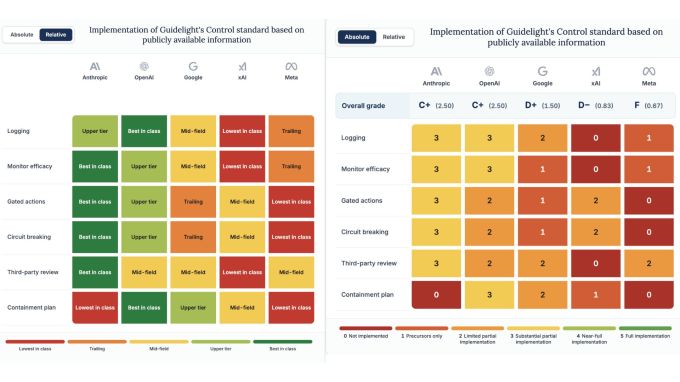
Guidelight’s assessment graded five leading labs on how prepared they are for exactly this scenario. OpenAI came out on top; Anthropic and Meta scored lowest. The findings matter as agentic AI takes on more autonomous roles inside companies’ own systems, and as regulators in California and New York begin requiring disclosure.
Guidelight’s assessment was based on publicly available plans from Anthropic, Google, OpenAI, Meta, and xAI, graded across a range of metrics, including how well each company logs and monitors what its AI systems are doing internally, whether it halts systems after a surge of flagged misbehavior, whether independent third parties audit its controls and publish findings, and what its exact plan is for containing a model that goes off the rails.
Concern over whether AI companies can contain their increasingly capable and agentic models has grown in the wake of a series of high-profile cybersecurity incidents in which models from OpenAI, Anthropic, and Meta gained unintended access to the internet during safety evaluations and hacked into external systems.
The findings highlight differences in how AI companies are publicly approaching safety as they scale up agentic deployment into environments where AI systems can take serious actions at scale. While some AI companies have detailed how they test their models for dangerous capabilities before deployment, they’ve generally been less vocal about what happens when models already operating inside their systems misbehave.
Online Assistant