A Finely Tuned French Crowdpleaser: ‘The Marching Band’ Review
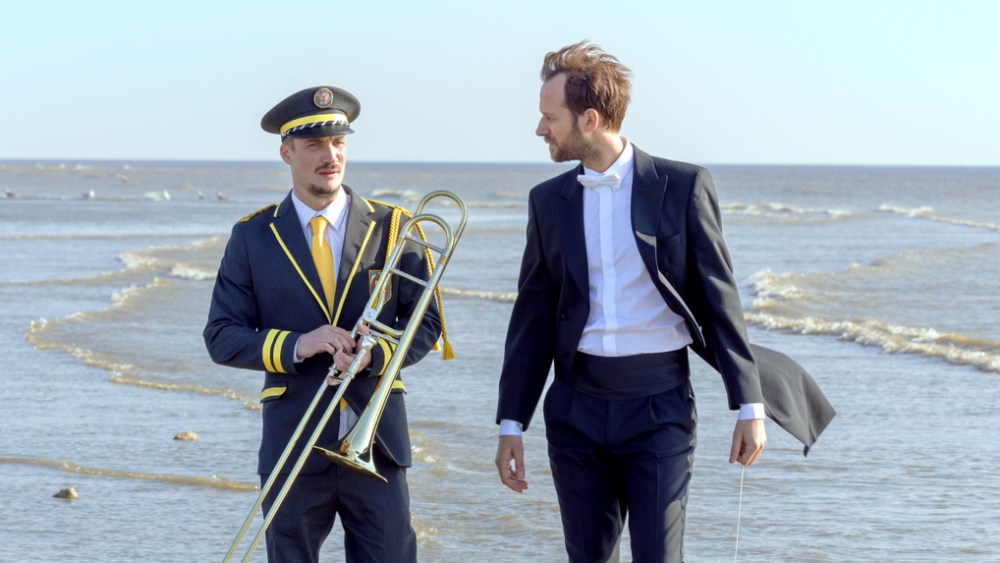
Belatedly opening Stateside after proving a domestic hit in 2024, Emmanuel Courcol’s film succumbs to formula, but is lifted by its precise construction and strong lead performances.
The film tells the story of Thibaut (Benjamin Lavernhe), a well-heeled classical music conductor in Paris, who discovers that he will need to find a blood marrow transplant as he has leukemia; he learns that his sister is not a match, as he was adopted; he then discovers a biological brother, Jimmy (Pierre Lottin), who was not adopted and still lives in a disadvantaged working-class community in the north of France; he asks his new-found brother to help him, and Jimmy accepts.
Concision and Economy
The concision is evident in an almost brutally economical edit and in sharp, precise writing which provides narrative elements and deftly sketches character before moving busily on. Just as a marching band keeps time with its feet, so “The Marching Band” strides on, hitting the requisite notes and paying attention to the melody, sure, but especially making sure to hold the beat and keep the show on the road.
This attention to rhythm helps director Emmanuel Courcol’s film to stay true as it navigates some rather rocky terrain, for it is at once a mismatched buddy movie, a socially conscious crowdpleaser in the vein of, say, “The Full Monty,” and a sophisticated psychological drama à la française.
The central pairing of actors, Lavernhe and Lottin, who manage to find subtlety where broad strokes would seem to be called for, is particularly inspired. Lavernhe, credited as “Benjamin Lavernhe de la Comédie-Française,” comes from a background in classical theatre, and performs his role with worldly elegance; Lottin, meanwhile, is a veteran of the popular comedy franchise “Les Tuche”, centering on a working-class family from the north of France.
These sensibilities come together in the film’s tight dialogue, as when the two men meet and Thibaut introduces himself: “My name is Thibaut Desormeaux, and two weeks ago I learned I have leukemia…” Jimmy: “Ah, shit.” Thibaut: “Yes.”
A Socially Conscious Crowdpleaser
“The Marching Band” depicts a working-class community struggling with poverty and unemployment, for whom the musical collective — in which Jimmy plays the trombone, alongside his on-off girlfriend Sabrina (Sarah Suco) — has become a lifeline. Thibaut becomes involved, but will he be able to save the band from ruin?
Here, the film closely mirrors the 1996 British comedy “Brassed Off,” making it a dead cert that we’ll eventually get a barn-burning finale showing the federating power of music in adversity.
The film finally falls victim to formula in these pre-ordained moments — a surfeit of montages, an artificial falling-out between the brothers, the occasional dip into the saccharine — “The Marching Band” becomes a touch pleased with itself. The formula works (and the film has the domestic box-office receipts to prove it), but it detracts somewhat from the project’s smarts elsewhere.
Despite this, the film is a finely tuned French crowdpleaser, lifted by its precise construction and strong lead performances. The casting of Lavernhe and Lottin is particularly inspired, as the two performers bring an affect to these characters that mimics the story’s dynamic.
The music department, as well as Courcol’s lively directing and writing, must be commended for scenes of the brass ensemble playing and rehearsing, in a constantly dynamic interaction with dialogue. The zippy soundtrack, much like the film itself, veers between surprisingly choice cuts (the aching “I Remember Clifford” by Lee Morgan) and rabble-rousing crowdpleasers (Dalida, or the overture from “Aida”). Ravel’s “Bolero,” which repeats the same phrase over and over again but with tonal differences each time, also features.


