Local Bounti’s Network Yields at Record Levels, Retail Momentum Broadened – Quarterly Update Report
Local Bounti’s Network Yields at Record Levels, Retail Momentum Broadened
Local Bounti’s (LOCL) 2Q results reinforce the transition from facility build-out toward yield, customer mix, SKU expansion, and operating leverage. Revenue increased 14% year-over-year (y/y) to $13.9 million from $12.1 million and rose ~4% sequentially from $13.3 million, driven by higher production and sales from Georgia, Texas, and Washington.
The company’s 1H26 revenue reached $27.2 million, up ~15% from $23.7 million in 1H25, extending the growth trend as LOCL converts higher output from its installed asset base into retail sales. Adjusted EBITDA loss narrowed 17% y/y to $5.8 million from $7.1 million and was broadly stable versus $5.7 million in 1Q26.
The y/y improvement indicates that higher revenue and tighter cost discipline are beginning to translate into operating leverage despite temporary gross-margin pressure during the quarter. With the three Stack & Flow-enabled facilities already at full harvestable capacity, incremental growth is increasingly coming from better asset productivity, although further gross-margin improvement is needed to accelerate progress toward positive adjusted EBITDA.
Food safety and traceability emerged as an important strategic theme this quarter, increasing retailer focus on the attributes that differentiate LOCL’s controlled-environment model. Retail sourcing conversations that historically centered on cost and availability are increasingly incorporating water sourcing, environmental control, traceability, and food-safety monitoring.
This shift is visible more broadly, with FMI’s 2026 research indicating that 31% of responding retailers plan to add food-traceability technology capabilities this year, while recent produce-safety events have highlighted the commercial impact of supply-chain exposure, with U.S. fresh-lettuce unit sales falling 9% w/w during July’s Cyclospora outbreak, per NielsenIQ data.
Against this backdrop, LOCL’s seed-to-package controlled environment and closed-loop water management reduce exposure to several variables associated with open-field agriculture, including runoff, wildlife, and changing outdoor conditions. With approximately 13,000 retail doors already serviced, this strengthens LOCL’s positioning with retailers seeking more traceable, controlled, and resilient fresh-produce supply and could support deeper commercial relationships over time.
Commercial momentum continued to build as previously announced wins converted into active placements and new accounts broadened distribution entering 2H26. The six-SKU Harris Teeter rollout across more than 250 stores and a separate large regional retailer covering approximately 160 stores are now fully launched and tracking in line with expectations.
The account base expanded further after quarter-end, with a new Mid-South retailer launching five SKUs across approximately 66 stores in July and a Rocky Mountain partner beginning shipments of four SKUs across approximately 110 stores in early August. LOCL also received bid awards during 1H26 extending supply arrangements with multiple national retail accounts across baby leaf lettuce and organic butter lettuce through 1Q27.
The progression from account wins to multi-SKU launches and longer supply commitments provides greater demand visibility and should support more efficient crop planning and facility utilization as retail programs scale.
The single-serve salad-kit relaunch adds a potentially meaningful value-added growth vector, while Romano Caesar and arugula continue to broaden LOCL’s opportunity within existing retail relationships. Following discussions with a major retailer, LOCL agreed to relaunch its single-serve salad-kit line through a Mid-Atlantic pilot covering approximately 400 stores this fall.
The initiative builds on encouraging performance from the family-sized Romano Caesar Salad Kit, which recorded a 75% increase in baseline velocity in 4Q25; an additional distribution center launched in May 2026 and has since reached velocities comparable with the existing network. Arugula also remains an active growth opportunity following successful 2025 launches from Washington and Texas, particularly where conventional supply has struggled to consistently meet retailer demand.
Together with baby leaf and organic butter lettuce program extensions through 1Q27, these initiatives give LOCL additional ways to deepen shelf presence and expand revenue per retail relationship without requiring a proportionate increase in physical capacity.
Yield remains the primary operating growth lever, with Georgia, Texas, and Washington sustaining the approximately 10% higher run-rate capacity benefit from tower upgrades completed in 4Q25. The three Stack & Flow-enabled facilities continue to operate at the highest yield levels in company history, with tower upgrades completed in 4Q25 supporting approximately 10% higher run-rate yield capacity.
Revenue increased 14% y/y in 2Q26, driven by increased production and sales from Georgia, Texas, and Washington, providing evidence that higher facility productivity is translating into incremental volume. These gains allow LOCL to increase production from the existing facility base and support continued revenue growth without adding comparable new capacity.
California is beginning to provide a second proof point for the yield-led strategy, while network-wide cost initiatives broaden the path to improved unit economics. Selective investments at the California facilities remain targeted to generate as much as a 20% improvement in yields, with initial work at one location already driving an approximately 10% increase in total production versus the prior-year period.
At the same time, more efficient seeding practices reduced seed costs approximately 20% y/y, while additional savings are being pursued across procurement, maintenance, labor efficiency, and freight management. These initiatives complement the ~10% yield-capacity improvement across Georgia, Texas, and Washington and reinforce the broader strategy of extracting more output at lower unit costs from the existing network.
The benefits were partly obscured in 2Q26 by temporary Georgia packing inefficiencies, making gross-margin recovery an important 2H26 indicator of whether these operating gains are translating into reported profitability.
Strategic partnership discussions are gaining relevance as retailer interest in controlled supply increases, while LOCL continues to keep future capacity tied to committed deals.
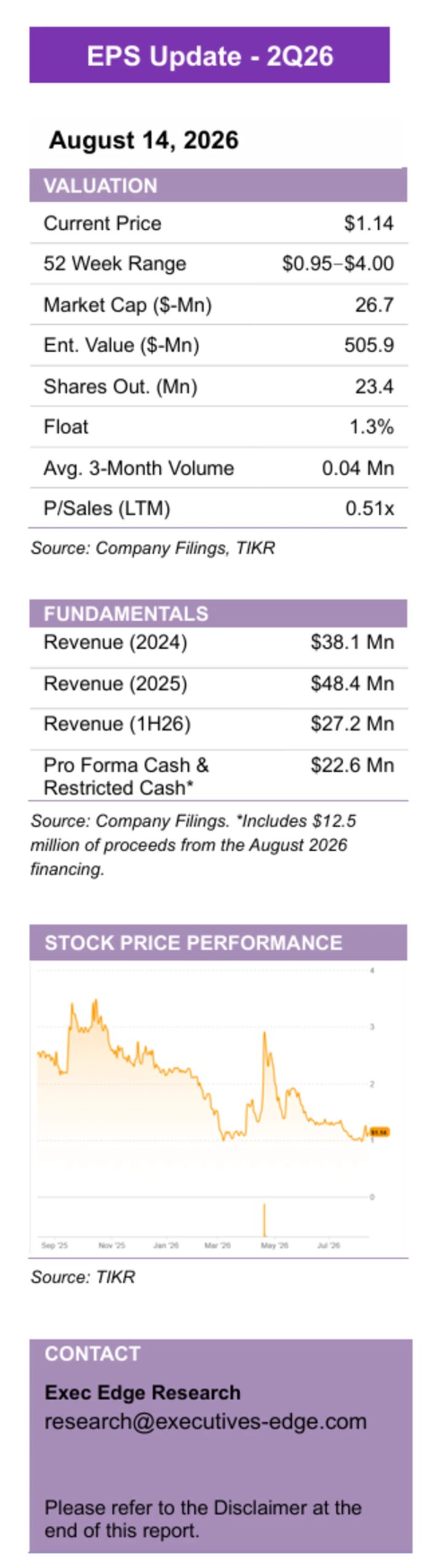
Shares trade at ~0.51x LTM sales, leaving rerating potential if margin recovery, EBITDA improvement, and balance-sheet execution continue.


