Rising Non-Accruals Signal Growing Risk in Private Credit
Rising Non-Accruals Signal Growing Risk in Private Credit
Private credit is entering a more challenging phase as non-accruals and other signs of borrower distress rise.
The industry has enjoyed years of strong growth, supported by expanding assets under management, robust investment activity, and attractive returns for investors. However, the credit cycle is turning, and the latest data suggest that rising borrower distress is becoming a more meaningful feature of the market.
In this report, we examine non-accrual exposure across the BDC market, beginning with a quick update on Q2 figures from the ten largest publicly traded BDCs, followed by a comprehensive analysis of non-accrual exposure across all registered US-based BDCs over the past three years, covering 213 distinct BDCs managed by 109 managers, representing an aggregate debt portfolio of $516 billion as of Q1 2026.
Key Takeaways
Reported non-accrual debt rose to 1.9% of total debt at cost in Q1, up 52 bps from the prior quarter.
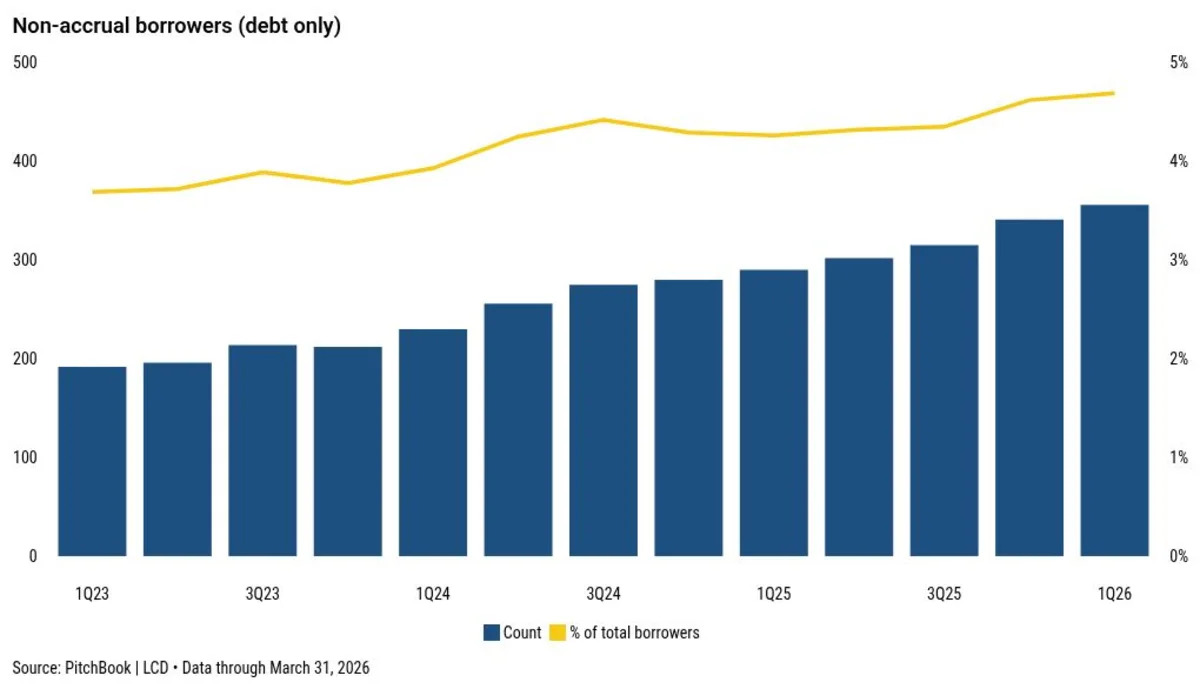
Non-accrual borrowers rose to 4.69% of all borrowers in Q1, up from 4.26% in the year-ago equivalent period.
Adjusted non-accrual exposure, counting all debt owed by borrowers with at least one non-accrual tranche, rose to 3.3% of total debt at cost in Q1, up 116 bps from the prior quarter.
Non-Accrual Levels Increase at the Top Ten Public BDCs in Q2
While not all BDCs have reported Q2 results, the ten largest publicly traded BDCs have, providing a useful proxy for the broader market. Analysis of the results confirmed that credit risk continued to build during the latest quarter, with non-accrual exposure increasing across every measure.
Debt tranches in non-accrual status at the top ten BDCs rose to 3.95% of total debt at cost in Q2, up 20 bps from the prior quarter. The balance increased slightly, by $89 million, to $3.3 billion in the latest quarter, despite a 2.3% contraction in the overall debt portfolio, which brought total debt at cost down to $83.6 billion.
Counting all debt tranches, performing and non-accrual, owed by borrowers with at least one non-accrual tranche, exposure at cost reached $5.0 billion, or 5.95% of total debt in Q2, an increase of 54 bps from the prior quarter.
Non-Accrual Debt Exposure is on the Rise
We compare non-accrual metrics on an as-reported basis with those on an adjusted basis. In the adjusted view, we treat a borrower’s entire debt amount, whether it is performing or not, as non-accrual whenever at least one BDC reports at least one of that borrower’s debt instruments to be in non-accrual status. This approach highlights the additional credit risk exposure for BDCs, which as-reported figures alone may understate.
As-reported non-accrual basis: While US-registered BDC funds have more than doubled over the past three years to an overall portfolio size of about $516 billion of debt at cost as of Q1 2026, the amount of debt for non-accrual borrowers has more than tripled over the same period.
The non-accrual share remained within a narrow 1.3-1.5% band until Q1 2026, when it increased 52 bps to 1.9% from Q4 2025. In dollar terms, non-accrual debt rose 39%, or nearly $2.8 billion, in Q1 alone, bringing the total to roughly $10 billion. This compares to just a 1% increase in total debt investments held by BDCs in Q1 2026 from Q4 2025 levels.
Adjusted non-accrual basis: The heightened credit risk exposure for BDCs is more pronounced when viewed on an adjusted non-accrual basis.
In BDC reporting, it is not unusual to see a loan facility from a borrower placed on non-accrual status, while another loan in the borrower’s debt structure isn’t. Also, a BDC holding a pro rata share of the same loan might not have it as non-accrual, while another BDC does. These situations could cause the level of distress in the overall BDC portfolio to be underestimated if only the debt tranche placed on non-accrual is counted.
As such, a key aspect of this analysis entails adjusting the definition of non-accrual status to extend it to all debt, performing or otherwise, of a borrower with at least one tranche of non-accrual debt. Under this lens, the distress borne by the non-performing loans extends to the borrower and carries through to the whole debt structure.
From this adjusted angle, non-accrual rates run higher. Over the three years leading up to Q1 2026 (at amortized cost), non-accruals across the BDC universe averaged 2.1% of total debt and stayed within a 2-2.4% range through year-end 2025. In Q1 2026, however, the rate jumped to 3.3%, an increase of 116 bps from Q4 2025 and 130 bps from the year-ago period. From a dollar perspective, the increase is even more striking. Adjusted non-accrual loans rose $6.1 billion to reach $17.3 billion as of Q1 2026, $7.3 billion more than the $10 billion in reported non-accrual debt. Two borrowers, Medallia and Inovalon, accounted for $4.4 billion of the Q1 2026 non-accrual total.