Source: techcrunch.com
OpenAI announced on Monday that it will start embedding an invisible watermark into text generated by its ChatGPT and Codex models for users located in the European Union. The move is a direct response to the transparency requirements of the EU AI Act, which came into force on August 2 and obliges providers of generative AI systems to make their output detectable by automated tools.
The watermark is not a visible logo or symbol; instead, it is a statistical pattern woven into the choice of words. OpenAI’s technique, dubbed textGrain, uses a secret key to slightly bias the model’s next‑word predictions. By applying hundreds of these subtle nudges across a sentence, a detector that possesses the same key can identify the AI‑origin of the text even after it has been copied, pasted, or reformatted. The company emphasized that the watermark does not reveal any information about the user who prompted the model.
OpenAI released a technical report detailing the method, co‑authored with researchers from the University of Pennsylvania and Yale. The report walks through an example where a secret key reorders the probability distribution of possible continuations, leaving a detectable signature that survives ordinary text edits.
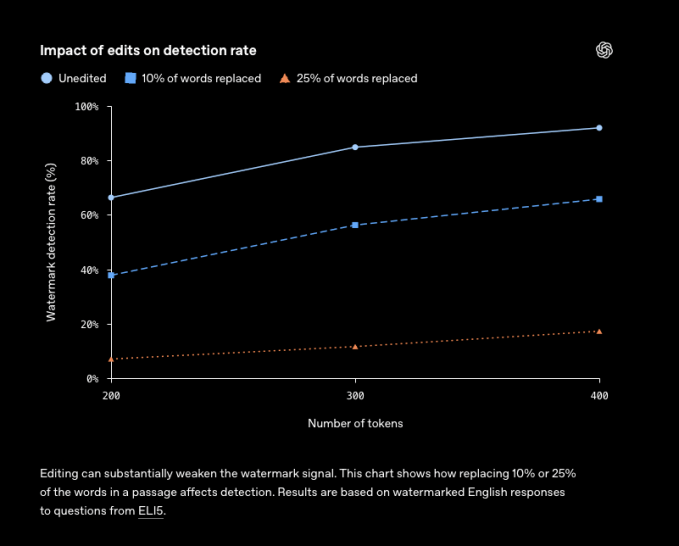
According to OpenAI’s internal testing, enabling the watermark does not cause a meaningful degradation in model quality or latency. However, the detectability is not foolproof. In one experiment, replacing approximately 10 % of the words with synonyms reduced the detection rate from about 92 % to 66 %. Short passages, mathematical answers, and heavily translated text also pose challenges for the detector.
Because of these limitations, OpenAI is initially granting access to the detection tool only to approved researchers and expert organizations. This controlled rollout aims to gather feedback on reliability and to explore responsible use cases before a broader release.
The company clarified that the absence of a watermark does not constitute proof of human authorship. A missing mark could result from overly short input, extensive post‑editing, or the use of a different provider’s AI system. OpenAI quoted its own statement: “[Watermarks] can indicate that an OpenAI system generated or processed part of a passage, but not how much human judgment, editing, or creativity went into it.”
This development follows a similar announcement from Anthropic, which said it would watermark text produced by its Claude model worldwide. That decision drew criticism from some Claude users who felt the watermark undermined their role as the source of instructions and creativity. OpenAI had previously experimented with a text watermark but held back, citing concerns that users might migrate to rival services that do not apply such markings, according to a 2024 Wall Street Journal report.
OpenAI, Anthropic, Google, Meta, and Microsoft are among the firms that have pledged to adhere to the EU’s voluntary code of practice on AI‑generated content, which encourages measures like watermarking to improve transparency and combat misuse.
Online Assistant